Tag
#php
Workout Journal App version 1.0 suffers from a persistent cross site scripting vulnerability.
LMS PHP version 1.0 suffers from a remote SQL injection vulnerability.
This Metasploit module exploits an unauthenticated remote code execution vulnerability in the Bricks Builder Theme versions 1.9.6 and below for WordPress. The vulnerability allows attackers to execute arbitrary PHP code by leveraging a nonce leakage to bypass authentication and exploit the eval() function usage within the theme. Successful exploitation allows for full control of the affected WordPress site. It is recommended to upgrade to version 1.9.6.1 or higher.
A command injection vulnerability in Artica Proxy appliance versions 4.50 and 4.40 allows remote attackers to run arbitrary commands via an unauthenticated HTTP request. The Artica Proxy administrative web application will deserialize arbitrary PHP objects supplied by unauthenticated users and subsequently enable code execution as the www-data user.
Insurance Management System PHP and MySQL version 1.0 suffers from multiple persistent cross site scripting vulnerabilities.
Craft CMS version 4.4.14 suffers from an unauthenticated remote code execution vulnerability.
Orange Station version 1.0 suffers from a remote shell upload vulnerability.
### Summary The `email` field in phpMyFAQ's user control panel page is vulnerable to stored XSS attacks due to the inadequacy of PHP's `FILTER_VALIDATE_EMAIL` function, which only validates the email format, not its content. This vulnerability enables an attacker to execute arbitrary client-side JavaScript within the context of another user's phpMyFAQ session. ### Details Despite using PHP's `FILTER_VALIDATE_EMAIL` function, the email field does not adequately validate the content of the email address. This means that malicious input, such as JavaScript code, can be accepted and stored in the database without being detected. When the stored data is retrieved and displayed on web pages, it is not properly sanitized to remove or neutralize any potentially harmful content, such as JavaScript code which leads to Stored XSS. ### PoC 1. Login as any user, go to the user control panel, change email to any valid email and intercept the request. 2. Modify the request’s email parameter to t...
### Summary The category image upload function in phpmyfaq is vulnerable to manipulation of the `Content-type` and `lang` parameters, allowing attackers to upload malicious files with a .php extension, potentially leading to remote code execution (RCE) on the system. ### Details In the file upload function of the category image, the `Content-type` can be manipulated to return an empty string for the extension and the `lang` parameter can be set to `.php.` to allow an attacker to save a file as `.PHP`. This allows the uploading of web shells which could lead to RCE on phpmyfaq. ### PoC 1. Generate a fake .GIF file that contains a php command using the tool `gifsicle` a. Cmd: `gifsicle < test1.gif --comment "<?php system('whoami'); ?>" > output.php.gif`  b. The contents of the file should look like this: %3c%2fscript%3e` 2. Browse to the particular news page and the XSS should pop up. 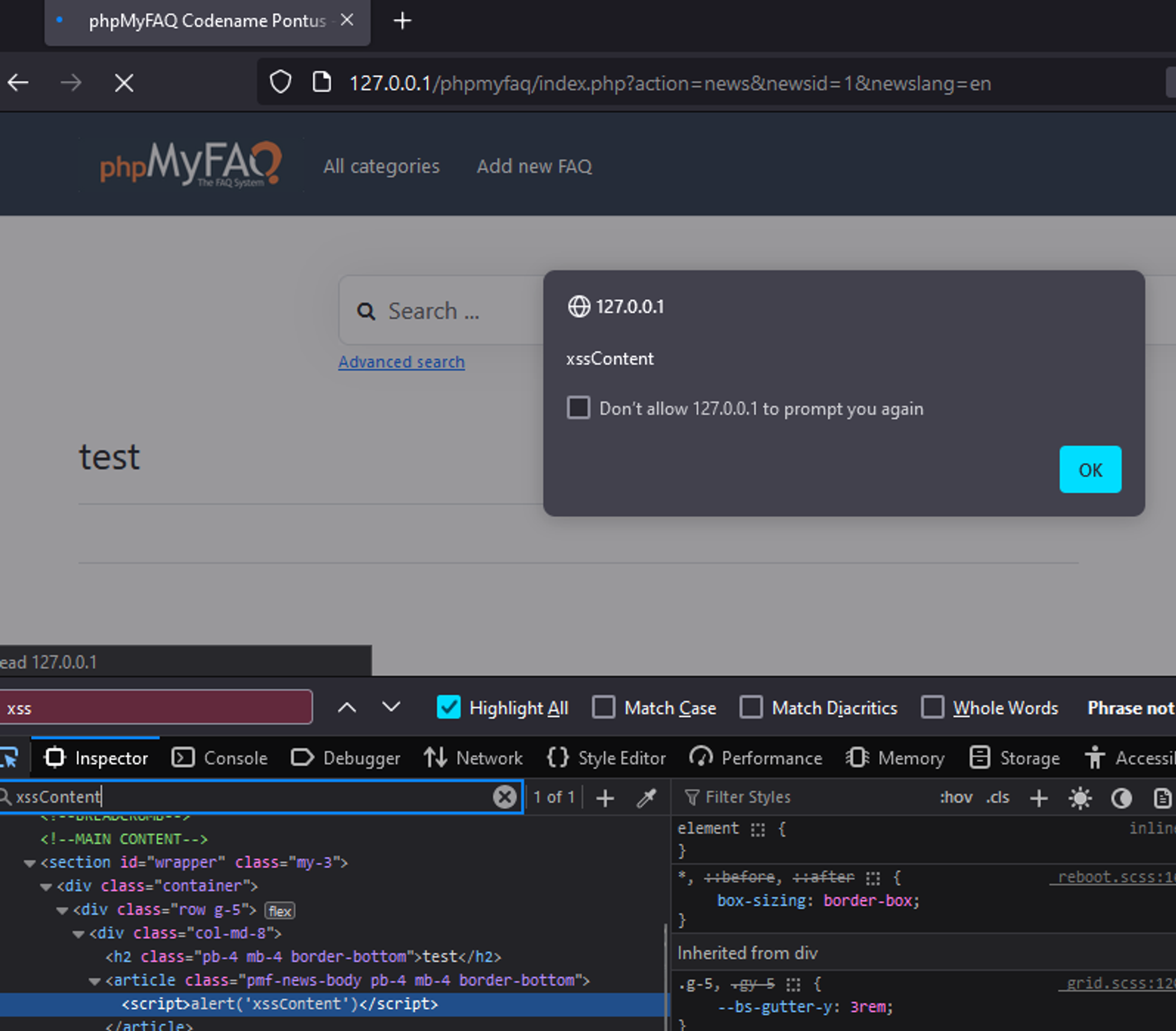 ### Impact This allows an attacker to execute arbitrary client side JavaScript within the context of another user's phpMyFAQ session